1. Regional Microclimate Dynamics & Severe Storm Exposure in Greater Oklahoma City Metro, OK
Situated squarely within central Oklahoma's severe weather belt, Greater Oklahoma City Metro's geographical positioning exposes residential and commercial roof envelopes to relentless atmospheric volatility. Positioned along the Southern Plains dryline corridor, Greater Oklahoma City Metro regularly encounters severe convective complexes triggered when dry desert air masses from the west intersect moist, unstable tropical air surging unhindered from the Gulf of Mexico. This persistent boundary creates violent supercells that generate localized tornadic wind shears, microbursts with straight-line velocities reaching 80 to 90 mph, and severe hail swarms dropping stones ranging from golf ball to baseball diameter.
In Greater Oklahoma City Metro, local terrain — ranging from open rolling prairies to developing residential subdivisions — offers minimal natural buffering against severe wind fronts. As high-velocity winds sweep across roof planes, they generate intense aerodynamic uplift pressures according to Bernoulli's principle. When these uplift forces exceed manufacturer nail-pull-through ratings or adhesive strip strengths, protective asphalt shingles peel backward and blow free from the roof deck, exposing bare synthetic underlayment to torrential rains. Furthermore, central Oklahoma experiences severe annual thermal fluctuations, where extreme summer radiant heat exceeding 105°F bakes asphalt binders, followed by rapid sub-freezing winter temperature drops that cause brittle thermal cracking across unreinforced materials.
Localized Microclimate & Repair Protocols for Greater Oklahoma City Metro, OK
- High-Wind Prairie Uplift Mitigation: Engineering eaves and rakes with ASTM D7158 Class H wind-resistant starter strips and 6-nail fastening patterns rated to resist 130 mph design gusts across Oklahoma, Cleveland & Canadian Counties.
- Tornado Alley Class 4 Hail Defense: Installation of SBS modified asphalt shingles certified under UL 2218 Class 4 standards to absorb heavy kinetic impacts without backside mat fractures.
- Ridge-to-Eave Dual Waterproofing: Application of high-temperature self-adhering SBS ice-and-water shield along valleys, eaves, and sidewalls extending past interior building envelope plates.
- Rapid Hydrostatic Containment: Deployment of heavy-duty 10-mil poly tarps anchored with exterior 2x4 timber battens and neoprene gasketed screws within 60 to 90 minutes of emergency dispatch.
2. Non-Destructive Moisture Diagnostics & FLIR Thermal Tracing in Greater Oklahoma City Metro
Pinpointing the precise origin of active water penetration across complex residential roof lines in Greater Oklahoma City Metro requires scientific diagnostic methodology rather than arbitrary guesswork. Rainwater entering through a fractured pipe boot, compromised dormer step-flashing, or wind-lifted shingle frequently travels horizontally along roof decking seams, electrical conduit runs, and ceiling rafters before dripping through interior drywall tens of feet away from the initial breach.
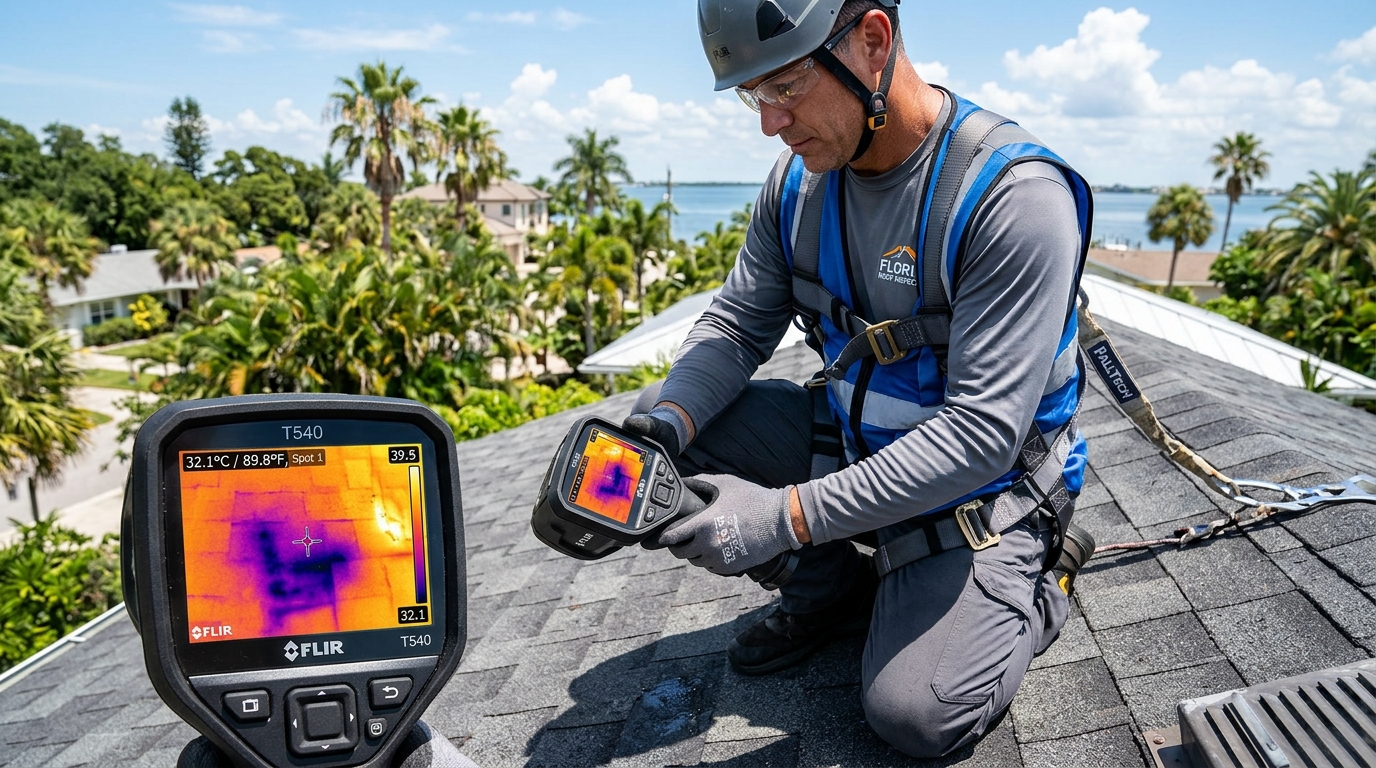
Dispatched independent roofing contractors utilize calibrated non-destructive testing (NDT) instruments. During evening thermal transition periods, technicians scan roof surfaces and interior ceilings using FLIR radiometric thermal cameras. Because damp fiberglass or cellulose building insulation possesses significantly higher thermal mass than dry building materials, moisture pockets appear distinctly on infrared displays as cool thermal anomalies. Technicians verify these infrared signatures using Tramex electronic impedance moisture meters, accurately mapping moisture boundaries without puncturing undamaged roofing components.
3. Step-by-Step Substrate Restoration Methodology in Oklahoma, Cleveland & Canadian Counties
Once forensic inspections determine the exact scope of storm damage in Greater Oklahoma City Metro, dispatched independent roofing specialists execute permanent structural restoration adhering to exacting engineering specifications:
- OSHA Fall Protection & Rigging Deployment: Field personnel install temporary OSHA 1926.502-compliant roof anchor brackets, securing shock-absorbing lanyards, full-body harnesses, and ladder standoffs before mounting steep-pitch Greater Oklahoma City Metro roof planes.
- Targeted Surgical Deconstruction: Compromised shingles, torn membranes, or fractured valley pans are carefully removed starting two courses above the water intrusion boundary, removing fasteners cleanly to prevent tearing adjacent sound materials.
- Subdecking Inspection & Timber Restoration: Exposed plywood or OSB sheathing is evaluated for moisture delamination and structural deflection. Compromised sheets are excised along rafter centerlines and replaced with exterior-grade CDX plywood secured with ring-shank nails at 6-inch perimeter spacing.
- Self-Adhering Membrane Installation: Application of high-temperature SBS modified polymer ice-and-water barrier directly to the cleaned structural deck, overlaid with tear-resistant synthetic underlayment fastened with plastic-cap pneumatics.
- Precision Component Integration: Interlocking replacement Class 4 impact shingles or standing seam panels matched to the existing roof system, integrated with 26-gauge galvanized steel flashings and hand-sealed with high-solids polyurethane elastomeric sealants.
4. Oklahoma Construction Industries Board (CIB) & Energy Code Compliance
All roofing restoration and emergency repairs executed in Greater Oklahoma City Metro and surrounding Oklahoma, Cleveland & Canadian Counties municipalities must comply strictly with the Oklahoma Roofing Contractor Registration Act and localized municipal adoptions of the International Residential Code (IRC) and International Building Code (IBC). Oklahoma state law mandates that any roofing contractor operating in the state must hold an active commercial or residential registration issued by the Oklahoma Construction Industries Board (CIB), maintain at least ,000,000 in commercial general liability insurance, and carry statutory workers' compensation coverage.
Dispatched independent roofing contractors secure all required municipal building permits, coordinate mandatory mid-point inspections with local building officials, and ensure compliance with current building energy efficiency mandates (minimum R-38 to R-49 attic thermal insulation and balanced passive attic ventilation calculated at a 1:150 or 1:300 net free area ratio). Ensuring complete regulatory compliance protects homeowner insurance claims, preserves manufacturer warranties, and prevents municipal stop-work notices.
5. Preventative Property Maintenance & Severe Storm Preparedness in Greater Oklahoma City Metro
Given Greater Oklahoma City Metro's location in the core of Tornado Alley, proactive roof maintenance is vital for preserving building structural integrity and preventing catastrophic water losses. Property owners should establish a bi-annual professional inspection cadence — scheduled each spring before the primary severe weather season begins and each autumn before freezing temperatures arrive.
Essential preventative measures include clearing accumulated leaves and organic debris from valley channels and gutter downspouts, maintaining an 8-to-10 foot clearance envelope between tree limbs and roof edges, and inspecting neoprene pipe boots and chimney mortar joints for hairline cracks. Following severe hail or wind storms across Oklahoma, Cleveland & Canadian Counties, property owners should check ground-level soft metals such as window air conditioning fins, metal mailboxes, and downspouts, which provide reliable collateral indicators that professional rooftop forensic evaluation is required.
Severe Storm or Active Roof Failure in
Zero web forms, zero automated delays. Speak directly with a live emergency intake coordinator to route vetted, licensed Oklahoma, Cleveland & Canadian Counties roofing contractors to your property now: